At 58, I Started Lying About My Memory. By 61, the Lies Got Complicated. Then a 1980s Study Explained What Was Really Happening.
Forget the crossword puzzles and brain games. If names vanish mid-sentence and you re-read the same page three times — this is why, and it's not what you think.


There's a moment nobody warns you about.
Mine came in a grocery store parking lot in Ohio. A woman waved at me — clearly knew me, clearly liked me — and for a full ten seconds I had nothing. No name. No face-file. Just a hot rush of panic and a smile I faked so well she never noticed.
I drove home and sat in the driveway for a while.
If you're over 50, I probably don't need to explain that moment. You've had yours:
Walking into a room and forgetting why — and laughing it off so nobody sees you count the seconds until it comes back
The name that disappears mid-sentence — your neighbor, your doctor, once (God help me) my own son-in-law
Re-reading the same paragraph four times and quietly putting the book down
Saying "I'm just tired" when what you mean is something is different and I'm scared
And the worst part isn't the forgetting. It's the covering. The little jokes — "senior moment!" — said fast, before anyone else can say it. The lists everywhere. The way you now rehearse a sentence in your head before you speak, just to be safe.
Somewhere along the way, I stopped asking "how do I fix this?" and started asking "how long can I hide it?"
Then one night at 1am, unable to sleep (another thing that started in my fifties), I found a number that changed everything.
The test 98% of children pass — and 98% of us fail
In the 1960s, a researcher named George Land built a creativity test for NASA to find their most inventive minds. Then he gave it to 1,600 five-year-olds.
98% of five-year-olds scored at "creative genius" level.
And here's the part that kept me up until 3am: Land's research said it isn't age. Nothing physically breaks. His conclusion was that something gets switched off — unlearned — by decades of routine, repetition, and running on autopilot.
"Non-creative behavior is learned." — George Land, summarizing three decades of the study's findings
Read that again. Not lost. Learned away. Switched off.
Which means — and I called my sister the next morning just to say this out loud — it might be switchable back on.
What nobody tells you about "just getting older"
Around the same time Land was running his tests, a neuropsychologist named Roger Sperry won the 1981 Nobel Prize in Medicine for research on how the two halves of your brain communicate.
The short version of decades of science since:
Children's brains show rich, constant communication between the two hemispheres. The whole brain lights up together. But as we settle into adult routine — same commute, same screens, same conversations, same everything — that cross-talk goes quiet. We end up running on half the machine.
That, researchers argue, is what the 98%-to-2% collapse actually measures.
Not lost capacity. Lost connection.
When I read that, I cried a little. Because it meant I wasn't broken. The wiring was there the whole time — it had just gone quiet. And I'd spent years trying to fix it with the one thing that never worked: trying harder.
The things I tried (so you don't have to)
I'm 64 now. In my fifties I tried everything you're supposed to try:
🧩 Puzzle books and brain-training apps. The research says they mostly make you better at… the app. My parking-lot moments didn't improve.
🧘 Meditation. Twice. I admire anyone who can stick with it. I lasted nine days.
💸 Neurofeedback clinics. Real science — and a few hundred dollars per session. Who has that kind of money in retirement?
💊 Supplements. A drawer full of bottles and nothing to show for it.
None of them addressed the actual problem: getting the two halves of a busy, ordinary brain talking to each other again — at home, without it becoming a second job.
Eight minutes. Eyes closed. That's it.
The same rabbit hole eventually led me to an audio method built on that exact line of research. Here's the whole principle:
- Two ears, two signals. Through headphones, each ear receives a slightly different sound pattern — one designed for each hemisphere.
- Both halves respond together. To make sense of the two patterns, both sides of your brain engage at once — the cross-talk that went quiet decades ago.
- Eight minutes, eyes closed. No mantras. No apps to master. Nothing to write down or remember (thank goodness).
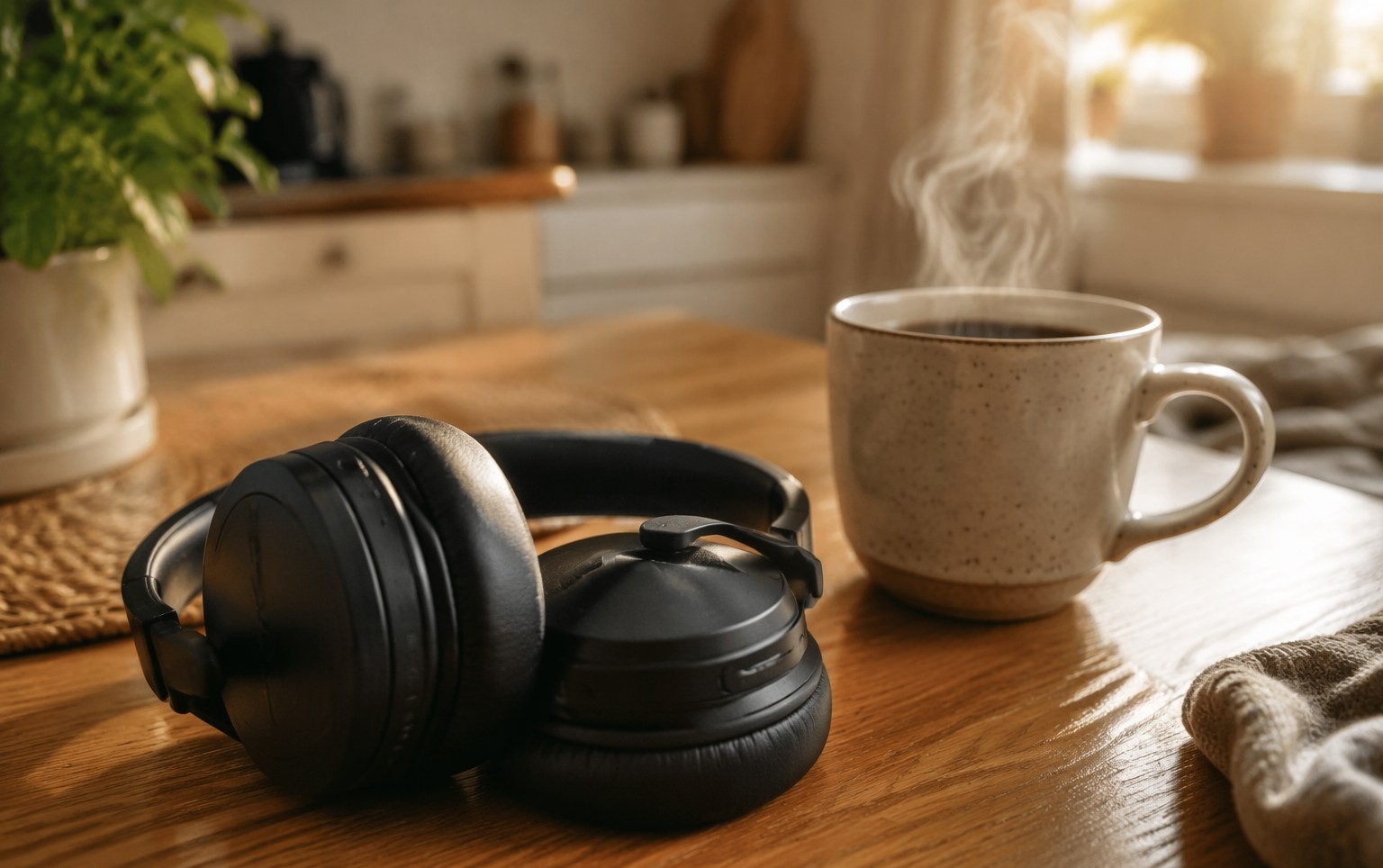
I was skeptical. Then I kept a diary.
It asked eight minutes of me, not eight months. So I tried it with my morning tea. Here's my honest record — mine alone; everyone's different:
Mostly just… pleasant. Eight quiet minutes before the house woke up. I kept going because it was easy to keep going.
I finished a novel without re-reading pages. Then I noticed I'd done the whole grocery trip without the list. Small things. I assumed it was a fluke.
Not a fluke. Words arriving on time. Names staying put. My head felt like a room where someone had finally opened a window.
And then the moment I'll remember forever: my granddaughter looked up at me and said,
Funny again. Sharp again. Me again.
Sound too good to be true? I thought so too.
At our age, we've all bought things that didn't work — that's exactly why the 90-day money-back guarantee mattered to me. If it does nothing for you, it costs you nothing. The only real risk is doing nothing and calling it "just getting older" for another year.
If the parking-lot moment was yours too
You've read this far, which tells me something. You're not the type to quietly fade. You're the type who fights.
The team behind this method put together a free video that explains the science far better than I can. The method itself costs less than a single neurofeedback session, and it comes with a 90-day money-back guarantee — which matters, because at our age we've all bought enough things that didn't work.
You have nothing to lose except eight quiet minutes a morning.
If 98%-to-2% bothered you the way it bothered me — start here.
References
Land, G., & Jarman, B. (1992). Breakpoint and Beyond: Mastering the Future Today. HarperBusiness. (NASA-derived creativity assessment, longitudinal results.)
The Nobel Prize in Physiology or Medicine 1981 — Roger W. Sperry, for discoveries concerning the functional specialization of the cerebral hemispheres. NobelPrize.org.
Reedijk, S. A., Bolders, A., & Hommel, B. (2013). The impact of binaural beats on creativity. Frontiers in Human Neuroscience, 7, 786.
Disclosure: This page is a paid advertisement presented in an editorial format. The author is compensated for purchases made through links on this page.
Results: Experiences described are the author's own and are not typical or guaranteed; individual results vary.
Health notice: This article is for general information only and is not medical advice. Nothing here is intended to diagnose, treat, cure, or prevent any disease.